
Cities of the Plain
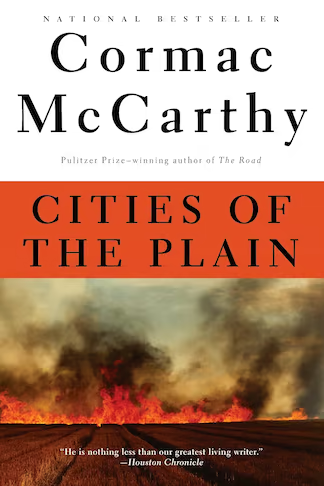
- Author: Cormac McCarthy
- Published: 1998
- Format: audiobook
- Started: 17 March 2026
- Finished: 13 April 2026
This is the final novel in The Border Trilogy. It brings together John Grady Cole from All the Pretty Horses and Billy Parham from The Crossing. I listened to this one as an audiobook so my “highlights” below are from times when I remembered to create a bookmark.
Chapter 8
This man who was dying was not a man given to sentimentality. He also had lost friends to death. He was not a man given to illusions. He knew that those things we most desire to hold in our hearts are often taken from us, while that which we would put away seems often by that very wish to become endowed with unsuspected powers of endurance. He knew how frail is the memory of loved ones. How we close our eyes and speak to them, how we long to hear their voices once again. And how those voices and those memories grow faint and faint until what was flesh and blood is no more than echo and shadow. In the end, perhaps not even that. He knew that our enemies by contrast seem always with us. The greater our hatred the more persistent the memory of them so that a truly terrible enemy becomes deathless. So that the man who has done you great injury or injustice makes himself a guest in your house forever. Perhaps only forgiveness can dislodge him. Such then was this man’s thinking. 5:48:46 – 5:50:02
If you sincerely want to hear all about what is wrong with you and what you ought to do to rectify it all you need to do is let them in-laws on the place. You’ll get a complete rundown on the subject and I guarantee it. 6:08:54 – 6:09:05
Chapter 9
My daddy once told me that some of the most miserable people he ever knew were the ones that finally got what they always wanted. 6:42:23 – 6:42:28
Chapter 11
The man and his burden passed on forever out of that nameless crossroads, and the woman stepped once more into the street and the children followed and all continued on to their appointed places, which as some believe were chosen long ago, even to the beginning of the world. 8:11:06 – 8:11:25
Chapter 12
But what is your life? Can you see it? It vanishes at its own appearance. Moment by moment. Until it vanishes to appear no more. When you look at the world is there a point in time when the seen becomes the remembered? How are they separate? It is that which we have no way to show. It is that which is missing from our map and from the picture that it makes. And yet, it is all that we have. 8:32:00 – 8:32:27
Chapter 13
What he saw was the strangeness of the world, and how little was known, and how poorly one could prepare for ought that was to come. He saw that the man’s life was little more than an instant, and that as time was eternal therefore every man was always and eternally in the middle of his journey, whatever be his years or whatever distance he had come. He thought he saw in the world’s silence a great conspiracy, and he knew that he himself must then be a part of that conspiracy, and that he had already moved beyond his captors and their plans. If he had any revelation, it was this, that he was repository to this knowing, which he came to solely by his abandonment of every former view. 8:49:46 – 8:50:34
These dreams reveal the world also, he said. We wake remembering the events of which they are composed, while often the narrative is fugitive and difficult to recall. Yet it is the narrative that is the life of the dream, while the events themselves are often interchangeable. The events of the waking world on the other hand are forced upon us, and the narrative is the unguessed axis along which they must be strung. It falls to us to weigh and sort and order these events. It is we which assemble them into the story which is us. Each man is the bard of his own existence. This is how he is joined to the world. For escaping from the world’s dream of him this is at once his penalty and his reward. 8:51:43 – 8:52:32
It is senseless to claim that things exist in their instancing only. The template for the world and all in it was drawn long ago. Yet the story of the world, which is all the world we know, does not exist outside of the instruments of its execution. Nor can those instruments exist outside of their own history. And so on. This life of yours is not a picture of the world, it is the world itself, and it is composed not of bone or dream or time but of worship. Nothing else can contain it. Nothing else be by it contained. 8:59:52 – 9:00:32