
SPQR: A History of Ancient Rome
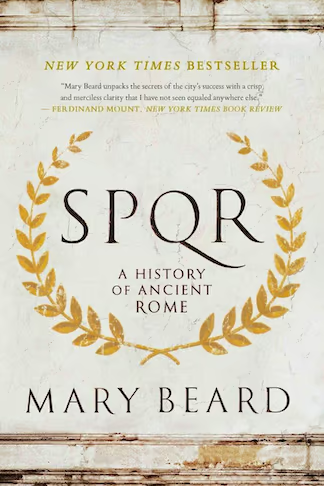
- Author: Mary Beard
- Published: 2015
- Format: paperback
- Started: 11 March 2026
- Finished: 23 April 2026
I found this book while wandering through the history section of the library. I only knew a bit about ancient Rome before, from taking an Ancient Civilizations class in high school. It took a while to get through it, but I enjoyed this book and learned a lot from it. Below are some notes I made and passages I highlighted.
Chapter 1: Cicero’s finest hour
- SPQR stands for Senate Populusque Romanus, which translates to “The Senate and People of Rome.”
- The book starts off looking at Cicero vs. Catiline in 63 BCE.
- Well-known quote: Quo usque tandem abutere, Catilina, patientia nostra? (“How long, Catiline, will you go on abusing our patience?”).
- Some important Roman writers: Livy, Ovid, Virgil.
Chapter 2: In the beginning
- Very little is known about the founding of Rome.
- Romulus & Remus myth: traditional founding date of 753 BCE.
- There is also a conflicting founding myth about Aeneas (after Troy).
- The Romans had slaves, but sometimes freed them and made them citizens, unlike Greek states.
- Rome was a city of foreigners, and early on provided asylum for others.
[…] the Romans were rather like people who acquire all kinds of brand-new kitchen equipment but can’t ever bear to throw away their old gadgets, which continue to clutter up the place even though they are never used. p. 79
- The Septimontium is an alternative founding story or precursor.
- Excavation only gives us a partial picture, of things that happened to be undisturbed over centuries of rebuilding.
Chapter 3: The kings of Rome
- An inscription under black stone in the Forum has Latin word rex (king).
This regal period is caught in that intriguing territory that straddles the boundary dividing myth from history. p. 95
- Best guess for the original population of Rome is a few thousand.
- Ancient Roman religion was different from ours: no doctrine, holy books, or belief system as such. They just knew the gods existed and did rituals.
- The king Numa Pompilius (if he existed) is credited with the 12 months. Ours today still descend from this: all the months are Roman.
- Their calendar inserted a leap month every few years.
- There is a complicated history of Tarquins being Etruscan, and questions about the Etruscan relation/takeover.
- Rape of Lucretia myth: turning point that led from monarchy to Republic.
Two central tenets of Republican government were that office holding should always be temporary and that, except in emergencies when one man might need to take control for a short while, power should always be shared. As we shall see, through the centuries that followed these tenets were increasingly reiterated, and became increasingly difficult to uphold. p. 127
Fifth-century BCE Athens bequeathed the idea of democracy to the modern world […]. Republican Rome bequeathed the equally important idea of liberty. p. 128
Chapter 4: Rome’s great leap forward
Ancient Roman historians were experts at turning historical chaos into a tidy narrative and always keen to imagine that their familiar institutions went back much farther than they really did. p. 131
- The sarcophagus of Barbatus in the tomb of the Scipios gives the earliest biographical narrative of an ancient Roman.
- Somewhere between 500 and 300 BCE Rome became as we know it today.
- In 390 BCE the “Gauls” sacked Rome, and then there was another founding by Marcus Furius Camillus.
- The Twelve Tables were bronze tablets with rules from early Rome that have been reconstructed, similar to Hammurabi’s code or Draco’s rules.
- Conflict of Orders: Plebeians fought and won equality with patricians using protest and mass walkout. It took place over more than a century.
- Big milestones: abolishing system of enslavement for debt, and allowing plebeians to be consuls. But some of this is mythical too.
- Alexander the Great did not fight the Romans but people wonder who would have won if he had.
- People at this time were pre-cartographic: they had no maps.
- The only obligation Rome imposed on the defeated at this time was to provide soldiers for Rome.
- By 300 BCE they probably had five hundred thousand troops.
Chapter 5: A wider world
- The beginning of the empire (military conquest) and the beginning of literature went hand in hand.
- Polybius was the first writer to pose some of the big questions about Rome’s history.
- Punic Wars: series of three wars against Carthage from 264 to 146 BCE.
- There were a few times that Romans buried human victims alive.
- The Battle of Cannae was fought against Hannibal in the Second Punic War, commanded by Fabius and then by Scipio Africanus.
- They lost many men and almost ran out of money.
Nothing underscores better the importance of Rome’s enormous reserves of citizens and allied manpower than the single fact that it continued to fight the war. p. 184
- Polybius was captured in a Greek town by Aemilius, then became his tutor.
Predictably, modern historians have found it hard to know quite where to fix the boundary between Polybius the Roman hostage and critic of Roman rule and Polybius the Roman collaborator. p. 186
“Democracy” (demokratia) was rooted politically and linguistically in the Greek world. It was never a rallying cry at Rome […]. Romans fought for, and about, liberty, not democracy. p. 189
The poor could never rise to the top of Roman politics […]. But this form of disequilibrium is familiar in many modern so-called democracies: at Rome too the wealthy and privileged competed for political office and political power that could only be granted by popular election and by the favour of ordinary people who would never have the financial means to stand themselves. p. 192
[…] the simple shorthand “Roman conquest” can obscure a wide range of perspectives, motivations and aspirations on every side of the encounter. p. 195
Cultural identity is always a slippery notion, and we have no idea how early Romans thought about their particular character and what distinguished them from their neighbours. […] “Greekness” and “Romanness” were as inseparably bound up as they were polar opposites. p. 205
Chapter 6: New politics
- Violent destruction of Carthage in 146 BCE, and of Corinth months later.
Whatever motivations lay behind the violence of 146 BCE, the events of that year were soon seen as a turning point. In one way, they marked the acme of Roman military success. p. 213
- Gradual destruction of peaceful politics, until Julius Caesar was officially made dictator, and then assassinated in 44 BCE.
When the story is stripped down to its barest and brutal essentials, it consists of a series of key moments and conflicts that led to the dissolution of the free state, a sequence of tipping points that marked the stages in the progressive degeneration of the political process, and a succession of atrocities that lingered in the Roman imagination for centuries. p. 216
- Tiberius Gracchus: grandson of Scipio Africanus, war hero at Carthage, land redistribution reformer, murdered in 133 BCE.
That raised an issue still familiar in modern electoral systems. Are Members of Parliament, for example, to be seen as delegates of the voters, bound to follow the will of their electorate? Or are they representatives, elected to exercise their own judgement in the changing circumstances of government? p. 226
- Gaius Gracchus: Tiberius’s younger brother, introduced subsidized grain.
- The Social War was one of the most deadly and puzzling conflicts in Roman history. After it, Rome extended full citizenship to most of Italy.
- Sulla: elected consul in 88 BCE, invaded Rome twice to take over from rivals; war against King Mithradates going on at the same time.
- Sullan period was defined by full-scale, long-term warfare within the city.
- Sulla used the dictatorship power for the first time in more than a century.
- Many reforms were dressed up as return to traditional Roman practice when they were nothing of the sort.
- Spartacus led a slave uprising that resisted Rome from 73 to 71 BCE.
Chapter 7: From empire to emperors
- Cicero prosecuted Gaius Verres for theft and other misdeeds while governor of Sicily. Verres went into voluntary exile.
By the 70s BCE, with vast territories under Roman sway as the result of two centuries of fighting, negotiation, aggression and good luck, the nature of Roman power and the Romans’ assumptions about their relationship to the world they now dominated were changing. In the broadest terms, the rudimentary empire of obedience had at least partly transformed into an empire of annexation. p. 255
[…] the empire created the emperors – not the other way round. p. 257
Roman rule was for the most part fairly hands off by the standards of more recent imperial regimes: the locals kept their own calendars, their own coinages, their own gods, their own varied systems of law and civic government. p. 257
- Gaius Gracchus made reforms to fight corruption, offer redress to victims.
- There was conflict between the senators and equites (knights).
But Romans had a tendency to use bribery as a convenient excuse whenever war, elections or court verdicts did not go the way they hoped. p. 267
Pirates in the ancient world were both an endemic menace and a usefully unspecific figure of fear, not far different from the modern “terrorist” […]. p. 271
- Cicero appointed Pompey to fight Mithradates.
- Pompey fancied himself “Pompey the Great” after Alexander.
Pompey has a good claim to be called the first Roman emperor. p. 274
- The First Triumvirate (or Gang of Three) was an unofficial deal made between Pompey, Crassus, and Julius Caesar.
- Crassus was decapitated in a campaign against the Parthian Empire.
- In 50 BCE the senate voted that Caesar and Pompey should simultaneously give up their commands; Pompey ignored it and Caesar marched into Italy.
- January 49 BCE: Caesar crossed the Rubicon, then 4 years of civil war, then 3 years fighting in Africa and Spain.
- Caesar’s victory over Mithradates’ son Pharnaces was commemorated by a placard with the words veni, vidi, vici (“I came, I saw, I conquered”).
- Julius Caesar was murdered on 15 March 44 BCE, the Ides of March.
- Caesar introduced the modern Western calendar with 365 days and leap years; Quintilis was renamed to July after him.
If the assassination of Julius Caesar became a model for the effective removal of a tyrant, it was also a powerful reminder that getting rid of a tyrant did not necessarily dispose of tyranny. p. 296
Chapter 8: The home front
But the idea that it was the norm, as the Romans insisted, to be a citizen of two places – to count two places as home – was fundamental to Roman success on the battlefield and elsewhere, and it has proved influential right up into the twenty-first century. This was a Roman revolution, and we are its heirs. p. 297
- Around a thousand private letters to and from Cicero have been preserved. They give us the best window into ordinary Roman life at this time.
“My guest [Caesar] was not the sort to whom you would say, ‘Please drop by again when you are next around.’ Once is enough.” p. 302
- Roman women had greater independence than most in classical Greece. But they had no freedom in choosing who or whether to marry.
- Around 1 out of 50 women died in childbirth. Babies that were unwanted were “exposed” (left to die). Around half of children born died by age 10.
- Pompey married Caesar’s daughter Julia to cement the alliance.
- Cicero’s wealth was enough to provide for 25,000 poor families, or to provide 30 men the minimum qualification for holding political office, but he was not in the ultra rich (Crassus had a property worth 15 times this).
- Around 20% of population of Italy was enslaved.
- For many, slavery was a temporary status.
Chapter 9: The transformations of Augustus
- Ides of March (44 BCE): around 20 senators assassinated Julius Caesar in the senate. More than a decade of civil war followed.
- The popular mood was not in support of the assassination.
- “Et tu, Brute?” is an invention of Shakespeare for Caesar’s dying words when he realized Brutus betrayed him.
- The senate ratified all Caesar’s decisions in return for amnesty for the assassins. In 42 BCE, the senate declared that Caesar had become a god.
- Caesar’s adopted son Gaius Octavius called himself Gaius Julius Caesar, but most called him Octavianus or Octavian.
- The Second Triumvirate was an official alliance between Octavian, Mark Antony, and Marcus Lepidus.
- Cicero spoke out against Antony, and was killed in 43 BCE.
- Octavian defeated Antony in 31 BCE at the battle of Actium.
- Antony committed suicide in 30 BCE; Cleopatra followed a week later.
- Octavian became the first emperor and longest serving ruler in Roman history, renaming himself to Augustus in 27 BCE.
Octavian almost certainly did not return to Italy from Egypt with an autocratic master plan ready to apply. But through a long series of practical experiments, improvisations, false starts, a few failures and, very soon, a new name intended to consign the bloody associations of “Octavian” to the past, he eventually devised a template for how to be a Roman emperor which lasted in most of its significant details for the next 200 years or so, and in broad terms much longer. Some of his innovations are still taken for granted as part and parcel of our mechanisms of political power. pp. 353–354
- He almost certainly looked nothing like the statues and portraits of him.
- He wrote Res Gestae (“What I Did”) at the end of his life.
- He explicitly focused on global conquest.
The point was that Augustus was cleverly adapting the traditional idioms to serve a new politics, justifying and making comprehensible a new axis of power by systematically reconfiguring an old language. p. 369
- One of his most significant innovations was establishing uniform terms of army employment, guaranteeing a pension for legionnaires from public expense rather than from their generals.
- He had a lot of trouble trying to produce an heir; eventually it was his wife Livia’s son from an earlier marriage, Tiberius, who became his heir.
- Augustus died on 19 August 14 CE.
Among his final words to his assembled friends, before a lingering kiss with Livia, was a characteristically shifty quotation from a Greek comedy: “If I have played my part well, then give me applause.” […] How Augustus managed to recast so much of the political landscape of Rome, how he managed to get his own way for more than forty years, and with what support, is still puzzling. p. 384
Every later emperor we shall meet was or at least impersonated Augustus. […] Whatever their idiosyncrasies, virtues, vices or backgrounds, whatever the different names we know them by, they were all better or worse reincarnations of Augustus, operating within the model of autocracy he established and dealing with the problems he left unresolved. pp. 384–385
Chapter 10: Fourteen emperors
- There were 14 emperors after Augustus excluding 3 short-term ones.
- After Augustus, there was Tiberius, then Gaius (known by his childhood nickname Caligula, which translates to something like “bootikins”).
- Gaius was murdered by 3 members of the Praetorian Guard.
To put it another way, Gaius may have been assassinated because he was a monster, but it is equally possible that he was made into a monster because he was assassinated. p. 397
- The idea of “good” and “bad” emperors (promoted by Edward Gibbon in The History of the Decline and Fall of the Roman Empire) is very misleading.
- To their face all emperors were called Caesar.
- After 117 CE the emperors started having beards. We don’t know why.
- Successions were fraught with violence and allegations of treachery.
Augustus was trying to invent from scratch a system of dynastic succession, against the background of a fluid set of Roman rules about the inheritance of status and property. p. 415
- Vespasian succeeded Nero through military force.
- Vespasian is said to have healed a blind man by spitting in his eyes.
- After the end of the first century CE, succession went via adoption.
Adoption in Rome had never been principally a means for a childless couple to create a family. If anyone just wanted a baby, they could easily find one on a rubbish heap. p. 418
Succession always came down to some combination of luck, improvisation, plotting, violence and secret deals. The moment when Roman power was handed on was always the moment when it was the most vulnerable. p. 420
Hadrian began with fine words about having no senator put to death without trial, though it was not long before four ex-consuls were executed after no more than a rumour of a plot against the new ruler. p. 422
- After Cicero, the best known Roman letter writer is Pliny the Younger.
Most Roman senators chose a mixture of collaboration and dissidence, which the first Augustus’ awkward compromise between senatorial power and senatorial service made almost inevitable. p. 428
- Throughout the Roman world, the emperor was treated like a god.
- The senate incorporated many emperors (and their relatives) into the official pantheon after they died.
Chapter 11: The haves and the have-nots
Vociferous Roman disapproval of “luxury” and admiration of simple, old-fashioned peasant life coexisted, as they often do, with massive expenditure and luxurious habits. p. 435
- The rich paraded their wealth with large houses and private villas.
- They also sponsored amenities for their local communities, such as libraries, amphitheatres, and temples.
- For the most part, rich and poor lived side by side.
- The city was disgusting, with trash and human waste dumped in streets.
Elite Roman writers were mostly disdainful of those less fortunate, and less rich, than themselves. Apart from their nostalgic admiration of a simple peasant way of life […] they found little virtue in poverty or in the poor or even in earning an honest day’s wages. p. 440
- Wage labor was considered dishonorable (should earn from your estates).
- The majority of the population was peasant farmers.
- It’s hard to know about the poorest: they leave no archaeological traces.
- Most Romans worked their entire life. Only soldiers had a retirement.
- Children started hard labor as early as four years old.
- Work was important to the social identity of ordinary Romans.
- Local trade associations (collegia) flourished across the empire.
- There was a double standard around gambling being considered disgraceful for poor people, while the rich did it too, including emperors.
- Life was precarious; it could easily be derailed by illness, fire, or flood.
Most victims of crime would have relied on their own strong arms or friends, family or local vigilantes to get even with the person they believed responsible. p. 463
- The sophisticated system of law had little impact for those below the elites.
- It’s estimated less than 20% of men in the empire were literate, but it must have been much higher in urban communities.
Chapter 12: Rome outside Rome
- In 109 CE, Pliny the Younger went to be governor of Bithynia.
- Letters between him and Trajan survive. It would have surprised them to learn that their famous exchange is about how to deal with the Christians.
- After Augustus, the expansion of the empire slowed.
- The boundary of empire was often imprecise, but Hadrian’s Wall in England is a counterexample.
- Except for the druids and Christians, the empire mostly left people’s cultures and traditions alone.
- At any time there were no more than around two hundred elite Roman administrators governing the provinces.
Pre-existing local hierarchies were transformed into hierarchies that served Rome, and the power of local leaders was harnessed to the needs of the imperial ruler. p. 493
- Romanisation of cultures was mostly bottom-up, not imposed top-down.
In fact, the interaction between Roman and other cultures in the empire is striking for the variety of forms it took and for the very diverse hybrid versions of Roman (and sometimes “not-Roman”) culture that were the result. p. 497
- Plutarch wrote pairs of biographies comparing Greek and Roman figures.
- Hadrian’s Pantheon was completed in the 120s CE. It has columns 12 m high cut from single block of Egyptian granite 2,500 miles away; each column would have taken three men more than a year to carve out.
The Romans, he [Calgacus, according to Tacitus] insists, are the robbers of the world, insatiable for domination and profit. And in a much-quoted phrase that still hits home, he sums up the Roman imperial project: “they create desolation and call it peace,” “solitudinem faciunt, pacem appelant.” p. 516
- Rebellions were rare and mostly carried out by provincial aristocracy.
- The Jewish Revolt (66 CE) stemmed from distrust between the ruling class in Judaea and the Roman authorities, after the governor flogged and crucified a number of Jews who were also Roman citizens.
- Christianity is hard to pin down in the two centuries after the crucifixion of Jesus. By 200 CE, there were around 200 thousand Christians.
But to a remarkable and in some ways unexpected degree, the Jews managed to operate within Roman culture. For the Romans, Christianity was far worse. First, it had no ancestral home. In their ordered religious geography, Romans expected deities to be from somewhere […]. But Christianity was defined entirely by a process of spiritual conversion that was utterly new. p. 519
At the same time, the success of Christianity was rooted in the Roman Empire, in its territorial extent, in the mobility that it promoted, in its towns and its cultural mix. […] The irony is that the only religion that the Romans ever attempted to eradicate was the one whose success their empire made possible and which grew up entirely within the Roman world. p. 520
- By 200 CE, roughly 20% of the free population were citizens, and more than half of senators were from provinces.
Epilogue: The first Roman millennium
- In 212 CE, the emperor Caracalla declared that all free inhabitants of the empire were Roman citizens. This added more than 30 million citizens.
After a thousand years, Rome’s “citizenship project” had been completed and a new era had begun. It was not an era of peaceful, multicultural equality, though. For no sooner had one barrier of privilege been removed than another was put up in its place, on very different terms. Citizenship, once granted to all, became irrelevant. Over the third century CE, it was the distinction between the honestiores (literally “the more honourable,” the rich elite, including veteran soldiers) and the humiliores (literally “the lower sort”) that came to matter and to divide Romans again into two groups, with unequal rights formally written into Roman law. p. 529
Rome in its second millennium was effectively a new state masquerading under an old name. Whether this millennium was one long, slow period of decline; a series of patchy cultural and political changes which eventually transformed the ancient world into the medieval; or an extraordinarily dynamic era of art, architecture and cultural reflection depends on your point of view. p. 530
- There was continuous civil war and faster emperor turnover. Emperors increasingly ruled from abroad. The senate declined in importance.
- We should not look to the Romans for how we ought to live today, but we can learn a lot by engaging with Roman history.
We do the Romans a disservice if we heroise them, as much as if we demonise them. But we do ourselves a disservice if we fail to take them seriously – and if we close our long conversation with them. p. 536